


Managing AI agents in SaaS: operational strategies for CTOs and SMB owners
If you’re deploying AI agents as part of your SaaS product, how do you maintain predictable performance as you scale? Managing AI agents in SaaS requires more than technical integration, it relies on systematic routines that drive stability, accountability, and operational value. This guide provides process-focused recommendations for setting up, monitoring, and improving AI agents within SaaS offerings.
Clarify what AI agent management means in SaaS
Begin by defining what managing AI agents actually involves for your SaaS environment. AI agents are automated software routines that use machine learning or other AI methods to make decisions or execute tasks. Managing them covers:
- Deploying and configuring agents within your current stack
- Tracking their output and operational status
- Managing errors, exceptions, or unexpected agent actions
- Rolling out updates to underlying models or business logic
- Maintaining security controls and regulatory compliance
This breakdown lets you pinpoint where your existing architecture or processes may be vulnerable. For instance, does your update mechanism allow for zero-downtime rollouts? Are your monitoring tools integrated with escalation notifications? Framing the problem at this level helps target investments and team responsibilities.
Defining each management area also makes it easier to attach metrics and set improvement goals. For example, which deployment failures are tolerable? How quickly should model updates propagate? These definitions help drive operational maturity and encourage continuous assessment.
Review your current AI agent landscape and operational weaknesses
Start with a practical audit. Ask yourself:
- Which tasks are assigned to AI agents, and how are those tasks measured?
- What is your typical agent deployment and update flow? Is it automated or manual?
- Which systems provide insight into agent performance and error conditions?
- How are agent failures escalated and resolved?
- Are your AI agents covered by the same security and compliance policies as other services?
Gaps will emerge from this analysis. Vague agent responsibilities often lead to unclear monitoring, making troubleshooting difficult. If deployments are manual, human error becomes more likely and slows down iteration. Consider your alerting pipeline, does it inform the right team members, or is it generating too much noise? Also, check that AI agents are included in regular security reviews, including permission boundaries and sensitive data handling.
Don’t overlook operational reviews such as postmortems or incident analyses. These provide concrete lessons about where management or workflow assumptions break down.
Design scalable deployment pipelines for AI agents
Scaling up AI agent workloads across many SaaS tenants hinges on reproducible deployment and update routines. Key architectural elements include:
- Containerization and orchestration. By packaging AI agents in Docker containers and orchestrating them with tools like Kubernetes (Kubernetes official documentation), you can automate scaling, health checks, and upgrades. For instance, Kubernetes can automatically spin up more agent instances when demand rises and retire them when not needed, supporting cost control.
- Automated CI/CD pipelines. Integrate automated tests and deployments for both agent code and underlying models. Early validation reduces the risk of production failures, while automated rollouts shrink the manual workload for your team.
- Version management and rollback planning. Tag agent releases and keep detailed changelogs. This enables safe rollbacks if a new version causes issues, supporting fast recovery with minimal disruption.
Imagine piloting a new agent model: with a structured CI/CD setup, you can vet it in staging, then gradually deploy it to production. If KPIs drop, revert with a single tagged release. These disciplined routines require coordination between data science, ops, and engineering. Clear automation triggers and handoff points keep the system predictable and traceable.
Ongoing monitoring of AI agent behavior and technical health
To catch problems early, set up detailed monitoring for your AI agents. Track:
- Completion rates and error counts by agent and task type
- Agent response time trends
- Compute usage (CPU, memory, network I/O)
- Signals of model drift or prediction accuracy changes
Create dashboards that visualize these numbers alongside historical baselines. Set up alerts when metrics exceed thresholds, and use anomaly detection to surface subtle issues. For example, a sudden error spike may mean a problematic data input or recent code change. Investigate using logs that tie agent actions to data inputs and code or model versions.
Integrate monitoring with incident management so that real issues get the right attention. Detailed logs provide evidence for root cause analysis, allowing teams to distinguish between problems with code, data, or infrastructure.

Systematic exception handling and error response
AI agents will encounter errors during operation. Standardize your response plans. Key mechanisms include:
- Retry routines that use exponential backoff to avoid flooding systems
- Fallbacks to manual review or a simplified algorithm when full automation fails
- Structured, contextual error logging for investigation
- Clear escalation paths so the right team members are contacted for critical incidents
Take, for instance, a network failure: an agent should retry with controlled timing, not overwhelm your backend. If error rates persist, the system should switch to a simpler process or hand off the task to humans. Escalation policies ensure that severe issues trigger timely human intervention. Post-incident reviews, grounded in detailed logs, help refine these protocols and prevent recurrences.
Safely updating AI models and agent workflows
Model and workflow updates are necessary for AI agents to remain effective. To avoid service disruptions:
- Test every update in a dedicated staging environment before rolling it out to users.
- Use incremental release methods such as A/B or canary deployments to validate impact with a subset of traffic.
- Ensure you can quickly rollback to a previous version if new issues appear.
- Keep all changes documented and communicate updates to involved teams and, where appropriate, customers.
For example, running A/B tests on a new model version allows you to compare metrics before migrating everyone to the new agent. Reliable rollback processes minimize exposure to regressions. Documentation supports internal troubleshooting and helps satisfy audit or customer information requests.
Security and compliance for managing AI agents in SaaS
AI agents can introduce new risks if not managed carefully. To mitigate exposures:
- Limit access to agent management interfaces using role-based permissions
- Encrypt all sensitive data, both in storage and during transfer
- Schedule regular security assessments and simulated attacks to uncover vulnerabilities
- Track compliance with industry standards such as GDPR or HIPAA as relevant to your business
Security is not a one-off task but a daily requirement. For instance, restricting agent deployment to authorized users reduces the risk of configuration drift or insider threats. Encryption ensures customer data remains safe, even if other layers fail. Routine assessments expose weaknesses before attackers do, and compliance tracking is essential for regulated industries.
Aligning AI agents with customer SaaS processes
Management of AI agents should not be isolated from your customers’ operational context. Focus on:
- Allowing customers to adjust relevant agent parameters
- Delivering clear, auditable records of agent actions and outcomes
- Facilitating integration with customer data sources via robust APIs
- Systematically collecting and acting on user feedback about agent performance
As a hypothetical: if your SaaS lets customers tune agent thresholds, they can tailor automation to their business rules. Providing transparent reports improves trust and enables customers to verify that agent-driven decisions align with their expectations. Direct API integrations minimize manual handoffs and unlock richer automation opportunities. Regularly reviewing customer feedback keeps agent development focused on practical needs.
Automation opportunities in managing AI agents
Reduce repetitive work and the chance for human error by automating:
- Health checks and automatic self-repair actions for underperforming agents
- Scheduled retrains of agent models using the latest data
- Automatic incident creation and assignment based on specific agent alerts
- Scripted processes for deployment and rollback
Decide which activities can be handed off to automation without losing necessary oversight. For example, automated health checks might restart stuck agents or switch to backup models. Scheduled retraining cycles help maintain accuracy as your data changes over time. Trigger-based incident assignment ensures urgent issues are never lost in a ticket queue.
However, it’s important to set clear boundaries. Some decisions still require human judgment, and all automated routines benefit from ongoing monitoring and periodic review.
Cross-functional teamwork: making AI agent management operational
Success in AI agent management depends on contributions from engineering, data science, operations, and security. Steps to coordinate effort:
- Assign explicit responsibilities for each step in the agent lifecycle
- Set up dedicated channels for rapid cross-team communication, especially during incidents
- Build and maintain a shared documentation hub
- Hold regular check-ins to discuss agent performance, blockers, and longer-term roadmaps
For example, data scientists might handle model tuning, ops manages deployments and runtime monitoring, and security leads on compliance checks. Avoiding silos ensures issues are surfaced and resolved quickly. Shared docs and periodic reviews help with onboarding and keep everyone aligned as systems evolve.
Measuring maturity in managing AI agents
Capture key metrics to spot improvement areas and track progress over time. Useful indicators include:
- How frequently you deploy changes, and how long each deployment takes
- Average time to detect and fix failures
- Customer feedback on AI-driven features
- Results from compliance audits
For instance, if your mean time to resolution is rising, investigate whether processes or team communication are slowing things down. If customer satisfaction scores lag, review whether agent automation aligns with client workflows. Tracking these numbers helps you prioritize what to automate, where to train teams, and which investments pay off.
If you’re looking to bring order and scalability to your AI agent management, contact SmartRabbitz for a detailed review tailored to your SaaS organization.
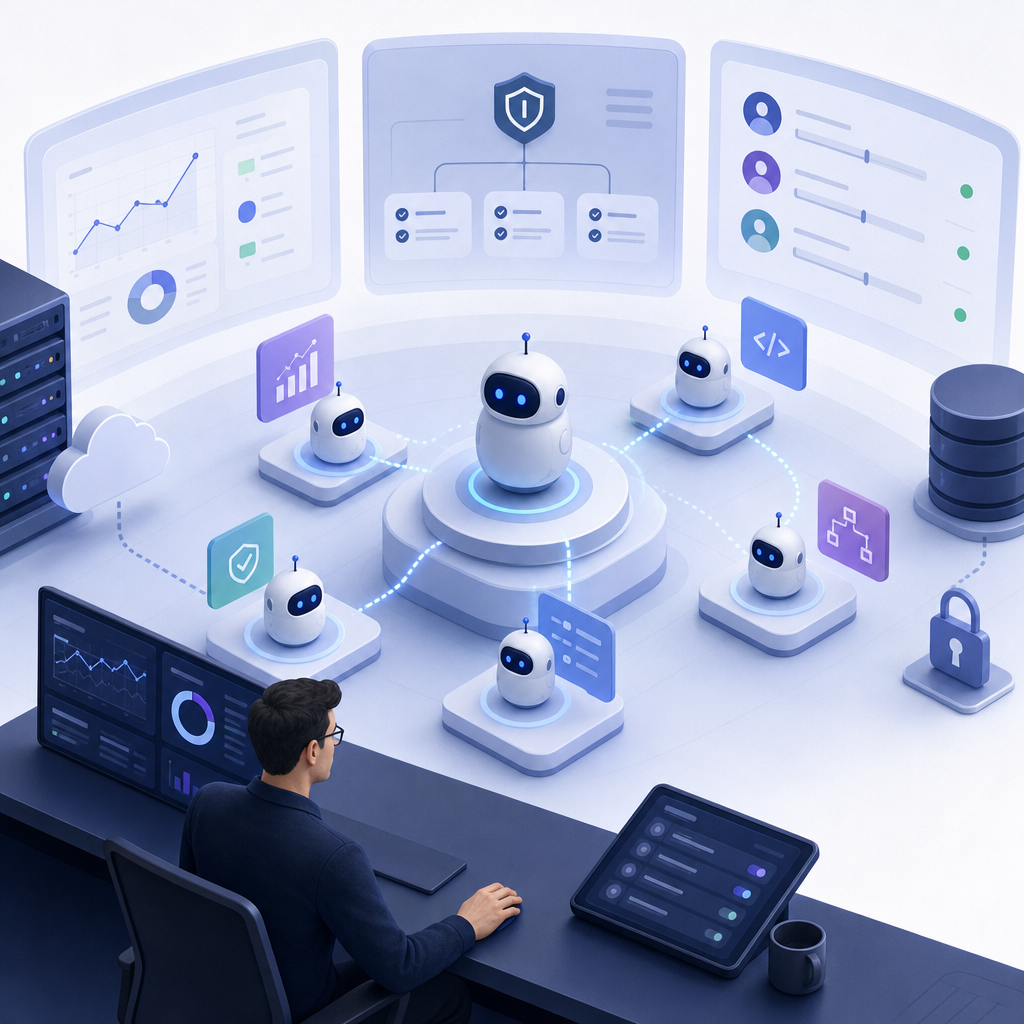
Addressing common challenges in managing AI agents
Most SaaS teams run into similar obstacles. Here are typical problems and specific countermeasures:
- Problem: Inability to trace agent decisions or outcomes.
Fix: Build in structured logging that links agent actions to source data and deployed model versions. This enables deeper analysis and accountability. - Problem: Model drift that gradually erodes agent reliability.
Fix: Schedule regular evaluations and retraining based on monitored accuracy and performance metrics. - Problem: Difficulty integrating AI agents with legacy SaaS modules.
Fix: Develop agents as modular components with versioned APIs, making integration and future updates easier. - Problem: Over-automation leading to missed exceptions.
Fix: Set escalation policies so routine issues are handled automatically, but edge cases are flagged for human review. This hybrid approach maintains efficiency and safeguards against missed anomalies.
Tackling these issues head-on strengthens operational trust and lays a solid groundwork for scaling AI-powered features.
Anticipating future trends in managing AI agents
Looking forward, several trends will shape how AI agents are managed within SaaS:
- Greater adoption of generative agents that handle complex, language-based tasks
- Expanding focus on making AI decisions explainable for users and regulators
- Use of federated learning to enable privacy-friendly AI model updates across decentralized customer data
- Integrating agent management with unified DevOps and MLOps toolchains for consistency and governance
Planning for these developments now supports smoother adaptation in the future. For example, prioritizing explainability tools may help navigate upcoming regulatory shifts, while federated learning can provide an entry point into markets with strict data privacy demands.
Want to discuss adapting your SaaS operations to leverage these trends? Reach out to SmartRabbitz for a strategy session.
Stepwise implementation for managing AI agents in SaaS
To operationalize AI agent management in your SaaS, follow a structured process:
- Clarify objectives. What business outcomes should your AI agents support? What are the non-negotiable operational requirements?
- Survey your current systems. Document current deployment, monitoring, and access controls.
- Choose appropriate tooling. Select container orchestration, CI/CD, and monitoring solutions that fit your team’s experience and SaaS architecture.
- Develop and formalize workflows. Establish written guides for deployment, incident response, updates, and compliance checks.
- Train all stakeholders. Provide detailed training (including cross-team sessions) so everyone understands new responsibilities and procedures.
- Pilot, then expand. Test with a limited rollout, collect operational data, and refine before scaling widely.
- Monitor and refine. Track key metrics, hold regular retrospectives, and iterate on processes as you grow.
This sequence limits risk and supports steady progress toward operational excellence in AI agent management in SaaS.
Calculating costs and demonstrating ROI in managing AI agents
Budget planning for AI agent management means accounting for:
- Infrastructure costs (compute, storage, networking required for agent workloads)
- Software licensing for orchestration, monitoring, and automation tools
- Personnel time spent on management and cross-functional collaboration
- Long-term maintenance and support
To justify these expenses, measure outcomes like reduced manual workload, faster feature delivery, improved customer experience, and any new revenue enabled by AI-driven services. For instance, automating customer support with agents may lower staffing expenses, while streamlined deployments mean less downtime and quicker access to innovation.
Track both operational metrics and financial KPIs to build a case for continued investment in AI agent management capabilities.
Operational mistakes to avoid in managing AI agents
Several process missteps can derail even the best AI agent management plans. Watch for:
- Skipping ongoing monitoring: Without real-time oversight, problems go undetected until customers complain.
- Pushing too much automation without checks: Lack of human review can mask subtle errors or compliance gaps.
- Leaving security out of scope: Untested agents may introduce vulnerabilities or mishandle sensitive data.
- Siloed team efforts: Poor collaboration leads to slow responses and missed handoffs.
- No documentation: Missing guides and records make troubleshooting, onboarding, and audits more difficult.
Addressing these issues early supports reliability, speed, and user trust as you grow your AI agent-powered SaaS solution.
Planning AI agents for your product?
SmartRabbitz Innovations helps SaaS teams and businesses in healthcare, retail, fintech and edtech design, deploy and operate AI agents with clear permissions, monitoring and human review built in. If you are planning an agent pilot or struggling to run one reliably, talk to our team about your workflow.