

AI Readiness for Web and Mobile Apps: Why Every Business App Needs It
AI readiness for web and mobile apps is becoming one of the most important priorities for modern businesses.
Today, every company wants smarter software. Customers expect faster support. Business teams want automation. Founders want better insights. Product owners want applications that can evolve with AI, GenAI, and intelligent workflows.
However, many existing applications are not ready for AI.
They may work well as normal web or mobile apps. But when the business wants to add AI-powered search, smart recommendations, automated summaries, copilots, or workflow automation, the app may need major rework.
That is why AI readiness for web and mobile apps is no longer a future topic. It is a business requirement.
What Is AI Readiness for Web and Mobile Apps?
AI readiness for web and mobile apps means your application is technically, functionally, and securely prepared to support AI features.
It does not mean every screen should have AI.
It does not mean adding a chatbot and calling it an AI strategy.
It means your app is ready to use AI in the right places, at the right time, without rebuilding the entire product.
An AI-ready application can support features such as:
- AI-powered search
- Smart recommendations
- Automated content summaries
- AI chat assistants
- Personalized user experiences
- Voice-based interactions
- Document understanding
- Workflow automation
- Predictive alerts
- Business insights from existing data
In simple words, AI readiness means your app will not become a roadblock when your business wants to adopt AI.
Why AI Readiness Matters Now
For many years, businesses built web and mobile apps mainly to digitize operations.
The goal was simple:
- Collect user data
- Show information
- Process transactions
- Manage workflows
- Improve customer access
That is still important. But user expectations have changed.
People no longer want apps that only store and display data. They want apps that understand context, reduce manual work, and help them take better decisions.
For example:
- A doctor wants a quick patient history summary instead of reading long records.
- A customer wants relevant product recommendations instead of browsing hundreds of items.
- A business owner wants simple insights instead of opening multiple reports.
- A support team wants AI-assisted replies instead of answering the same questions again and again.
- A student wants personalized learning support instead of generic content.
This is where AI readiness for web and mobile apps becomes important.
AI is no longer just an extra feature. It is becoming a new layer of digital experience.
AI Readiness Is Not Just About Adding a Chatbot
Many businesses believe that adding a chatbot means their application is AI-enabled.
That is a common mistake.
A chatbot can be useful, but true AI readiness goes much deeper.
An AI-ready app should be able to answer these questions:
- Is the application data clean and usable?
- Can AI safely access the required information?
- Are APIs available for AI integration?
- Can user permissions be respected?
- Can AI actions be audited?
- Can AI responses be reviewed by humans?
- Can AI usage and cost be tracked?
- Can new AI features be added without breaking existing workflows?
If the answer is no, the application is not truly AI-ready.
Why Existing Apps Struggle With AI Adoption
Many existing web and mobile applications were built before AI became a business priority.
These apps may be stable and useful. But they often have hidden technical limitations.
Common challenges include:
- Data stored in different places
- Poor data quality
- No proper API layer
- Hardcoded business logic
- Limited integration options
- No audit logs
- Weak role-based access control
- No clear separation between frontend and backend logic
- No usage tracking for AI-related features
These issues may not affect normal daily usage.
But when you try to add AI, they become expensive problems.
That is why AI readiness for web and mobile apps should be treated as part of application modernization.
Key Benefits of AI Readiness for Web and Mobile Apps
AI readiness gives businesses a strong advantage. It helps them move faster while reducing future risks.
1. Faster AI Feature Development
When your app is AI-ready, your team can add new AI features faster.
You do not need to rebuild the complete application. Instead, you can add AI capabilities through secure APIs, modular services, and well-planned workflows.
2. Lower Development Cost
Adding AI to an unprepared app can become expensive.
Your team may need to clean data, rewrite APIs, change backend logic, and redesign user flows.
AI readiness reduces this cost because the foundation is already prepared.
3. Better User Experience
AI-ready applications can offer smarter and faster experiences.
Users can search naturally, get recommendations, receive automated summaries, and complete tasks with less effort.
4. Improved Business Productivity
AI can automate repetitive work.
This helps teams save time in support, sales, operations, healthcare, finance, HR, education, and administration.
5. Better Use of Existing Data
Most businesses already have valuable data inside their applications.
AI readiness helps convert that data into insights, recommendations, alerts, and automated actions.
6. Stronger Competitive Advantage
Customers are starting to expect intelligent features in modern apps.
Businesses that prepare early can deliver better digital experiences than competitors who are still using traditional systems.
Where AI Can Be Used in Web Applications
Web applications are used by customers, administrators, employees, vendors, and business teams.
AI can improve web apps in many practical ways.
AI Dashboards
Instead of showing only charts and tables, AI dashboards can explain what is happening in simple language.
For example, a sales dashboard can explain why revenue dropped, which region performed well, and what action should be taken next.
Natural Language Reports
Users can ask questions like:
“Show me pending invoices from last month.”
“Which customers have not ordered in the last 90 days?”
“Summarize today’s support tickets.”
This makes reporting easier for non-technical users.
Document Processing
AI can extract, summarize, and classify information from documents.
This is useful for invoices, contracts, medical reports, resumes, insurance forms, and compliance documents.
AI Copilots
An AI copilot can help users complete tasks inside the web application.
For example, it can help create a quotation, summarize a customer profile, draft a response, or suggest the next action.
Where AI Can Be Used in Mobile Apps
Mobile apps are personal, fast, and user-focused. This makes them perfect for AI-powered experiences.
AI readiness for mobile apps can support:
- Voice search
- Smart notifications
- Personalized home screens
- AI chat support
- Image recognition
- Location-based suggestions
- Predictive reminders
- Smart onboarding
However, mobile AI should be designed carefully.
The app should not become slow, heavy, or confusing. Heavy AI processing should usually happen in the backend. The mobile app should focus on delivering a simple and smooth user experience.
What Makes an Application AI-Ready?
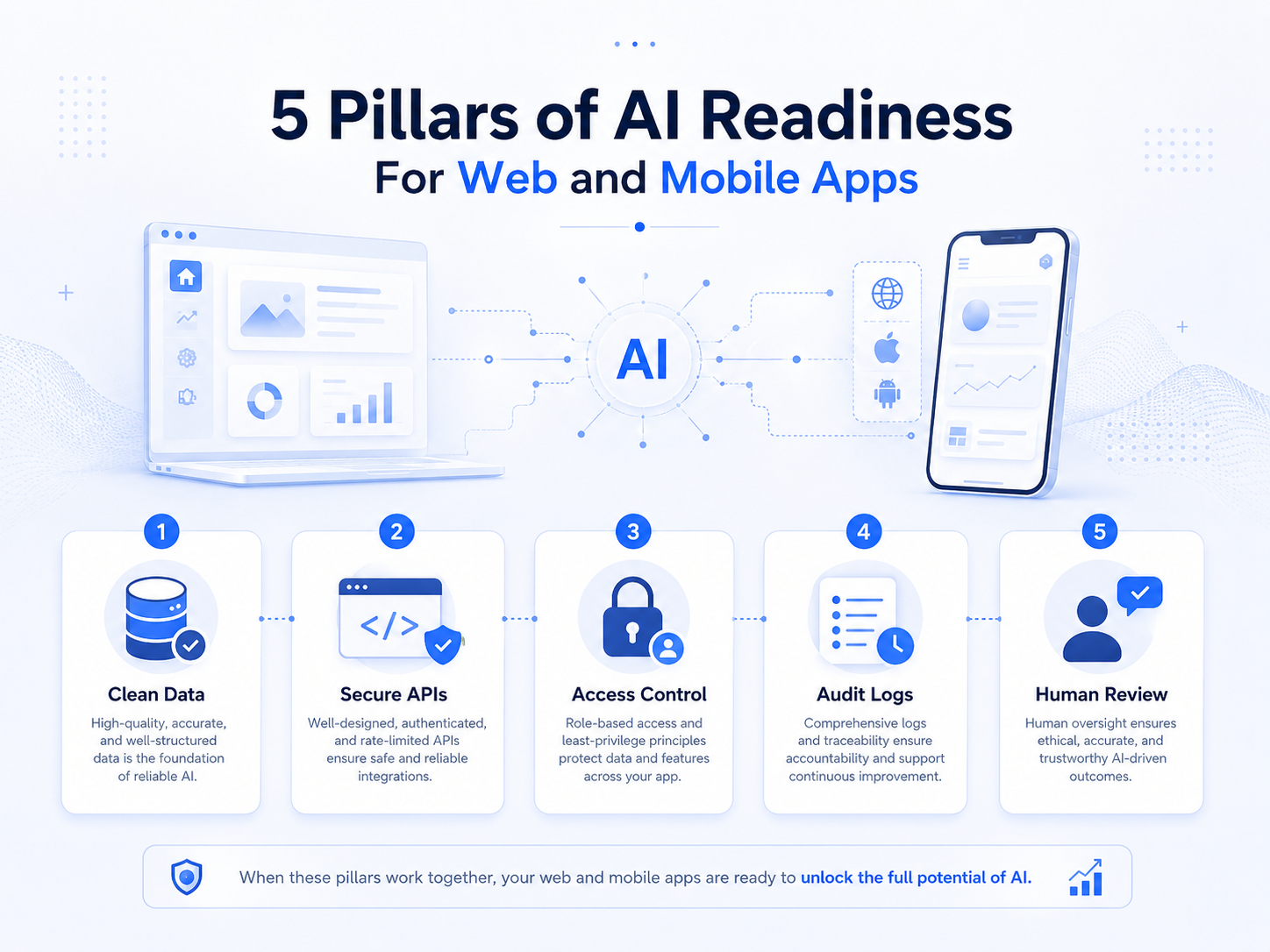
To achieve AI readiness for web and mobile apps, businesses should focus on the following areas.
1. Clean and Structured Data
AI depends on data.
If the data is incomplete, duplicated, scattered, or unstructured, the AI output will be weak.
Businesses should clean their data, organize it properly, and maintain useful metadata.
2. Secure API Architecture
AI systems need a safe way to access application data and workflows.
A strong API layer allows AI features to fetch information, process requests, and return results without directly disturbing the core system.
3. Role-Based Access Control
AI should follow the same access rules as users.
If a user is not allowed to see certain data, the AI should not show that data either.
This is very important for healthcare, finance, education, legal, and enterprise applications.
4. Audit Logs and Traceability
AI actions should be traceable.
Your system should be able to track:
- Who used the AI feature
- What question was asked
- What data was used
- What answer was generated
- Whether the answer was accepted, edited, or rejected
- Whether AI triggered any business action
This builds trust and accountability.
5. Human Review for Sensitive Decisions
AI should support people, not blindly replace them.
For sensitive workflows, human review is essential.
Doctors, finance teams, legal users, teachers, and managers should be able to approve, reject, or correct AI-generated outputs.
6. Modular System Design
An AI-ready app should be modular.
This means AI features can be added as separate components or services instead of changing the entire application.
Modular design makes the product safer, easier to maintain, and easier to scale.
7. AI Cost Monitoring
AI usage has a cost.
Every AI request may consume tokens, compute, storage, or third-party API usage.
Businesses should track AI usage by feature, user, department, customer, or workflow.
This helps avoid unexpected AI costs.
AI Readiness by Industry
AI readiness is useful across almost every industry.
Healthcare Apps
Healthcare platforms can use AI for patient history summaries, clinical documentation, appointment assistance, report understanding, and care coordination.
However, privacy, compliance, and doctor validation are very important.
E-commerce and Retail Apps
Retail apps can use AI for product recommendations, smart search, personalized offers, customer support, and inventory insights.
Education Apps
Education platforms can use AI for personalized learning, student progress analysis, content recommendations, doubt clarification, and teacher assistance.
Finance Apps
Finance applications can use AI for transaction analysis, document review, fraud signals, customer support, and financial insights.
SaaS Products
SaaS platforms can use AI copilots, smart workflows, automated reports, intelligent onboarding, and natural language search to improve product value.
How to Start With AI Readiness
You do not need to start with a large AI transformation project.
The best starting point is an AI readiness assessment.
This assessment should review:
- Current application architecture
- Database structure and data quality
- API availability
- Security and access control
- Possible AI use cases
- Integration complexity
- AI cost and scalability
- Compliance requirements
- Expected business impact
After this, the business can create a practical AI roadmap.
The roadmap should include short-term, medium-term, and long-term AI opportunities.
Simple AI Readiness Checklist
Use this checklist to understand whether your application is ready for AI.
- Is your data clean and structured?
- Do you have secure APIs?
- Can AI access data based on user roles?
- Do you have audit logs?
- Can humans review AI outputs?
- Can AI usage and cost be tracked?
- Can AI features be added without breaking the existing app?
- Do you have a clear AI roadmap?
If most answers are no, your application needs AI readiness planning.
AI Readiness Does Not Mean Rebuilding Your App
Many business owners worry that AI adoption means rebuilding everything from scratch.
That is not always required.
In many cases, AI can be added step by step.
You can start with one high-value use case, such as:
- AI-powered search
- Customer support assistant
- Document summary
- Report explanation
- Smart recommendation engine
- Internal AI copilot
Once the first AI feature proves value, the business can expand gradually.
This reduces risk and keeps the project practical.
Final Thoughts on AI Readiness for Web and Mobile Apps
AI readiness for web and mobile apps is becoming as important as mobile readiness and cloud readiness were in the past.
A few years ago, businesses asked whether they needed a mobile app. Today, mobile-first thinking is normal.
The same shift is now happening with AI.
Every app may not need advanced AI today. But every serious business app should be ready to adopt AI when the right use case appears.
The future belongs to applications that are not only digital, but intelligent.
So the most important question for business owners, founders, CTOs, and product teams is simple:
Is your web or mobile app ready for AI?
Need Help With AI Readiness for Your Application?
At SmartRabbitz Innovations, we help businesses assess, modernize, and AI-enable their existing web and mobile applications.
We work with SaaS companies, healthcare platforms, retail apps, enterprise portals, and custom business applications to identify practical AI use cases and build step-by-step AI roadmaps.
Our team can help you with:
- AI readiness assessment
- AI roadmap creation
- GenAI integration
- AI-powered search
- AI copilots
- Workflow automation
- Application modernization
- Secure AI implementation
Planning to add AI to your existing app?
Start with an AI readiness assessment and understand what is possible before investing in full-scale AI development.
Frequently Asked Questions
What is AI readiness for web and mobile apps?
AI readiness for web and mobile apps means preparing your application, data, APIs, security, and workflows so AI features can be added safely and effectively.
Does every app need AI?
Every app does not need AI immediately. However, every serious business application should be ready for AI so it can support future automation, personalization, and intelligent features.
Is adding a chatbot enough for AI readiness?
No. A chatbot is only one AI feature. True AI readiness includes clean data, secure APIs, role-based access, audit logs, human review, and scalable architecture.
Can AI be added to an existing app?
Yes. AI can often be added to an existing app without rebuilding everything. The best approach is to start with an AI readiness assessment and then add AI features step by step.
Why is AI readiness important for SaaS products?
AI readiness is important for SaaS products because customers increasingly expect smart workflows, AI copilots, automated insights, and natural language experiences inside software platforms.